Thursday, January 25, 2018


Report

60 years after Brown v. Board of Education, how racially balanced are America’s public schools?


It’s been more than 60 years since the Supreme Court, in Brown v. Board of Education, ruled “separate but equal” schools unconstitutional. In that time, school populations have diversified, thanks in large part to an increase in the numbers of Hispanic and Asian students attending U.S. schools.
But how closely do America’s traditional public and charter schools look like the communities they serve? And if schools’ student bodies don’t reflect their neighborhoods’ racial makeup, how come?
In “Balancing Act: Schools, Neighborhoods, and Racial Imbalance” (PDF), Grover J. “Russ” Whitehurst, Richard V. Reeves, Nathan Joo, and Pete Rodrigue examine the share of white, black, and Hispanic students at 86,109 public schools—both traditional and charters—across the country and identify schools whose racial imbalance with respect to their surrounding neighborhoods makes them ‘outliers’ within their states.
The analysis finds that though most schools are relatively similar to their surrounding neighborhoods in terms of racial makeup for white, black, and Hispanic students, there’s a lot of variation between school districts and states. Charter schools, in particular, display greater racial imbalances than traditional public schools and are on average 6 percent more black than their neighborhoods. When compared to traditional public schools, charter schools are on average approximately 14 percent more black, 22 percent less white, and 8 percent more Hispanic.
Want to see how your school compares to other schools within your district? Search for it in a new interactive, or read on for more top-level findings.


Most schools look like their neighborhoods

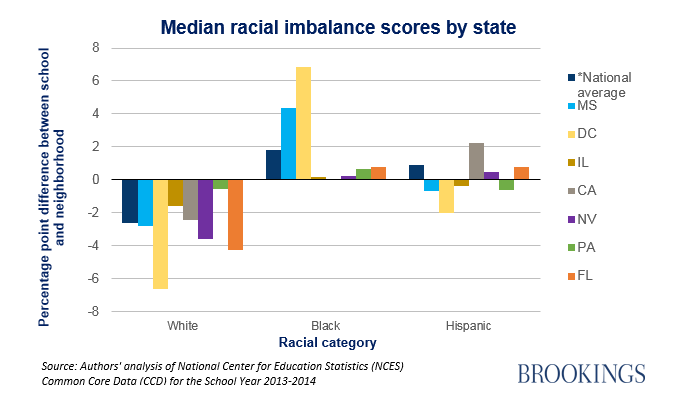
The authors find that many schools are similar, in terms of their racial composition, to the neighborhoods in which they are located. The average U.S. public school (including charter and magnet schools) is 2.6 percent less white, 1.8 percent more black, and 0.9 percent more Hispanic than its surrounding neighborhood.

More schools are “outliers” in terms of black student representation


Though most schools are similar to their surrounding neighborhoods, approximately one-third are outliers. Further, schools that qualify as outliers tend to have either an overrepresentation of black and Hispanic students, or an underrepresentation of white students.
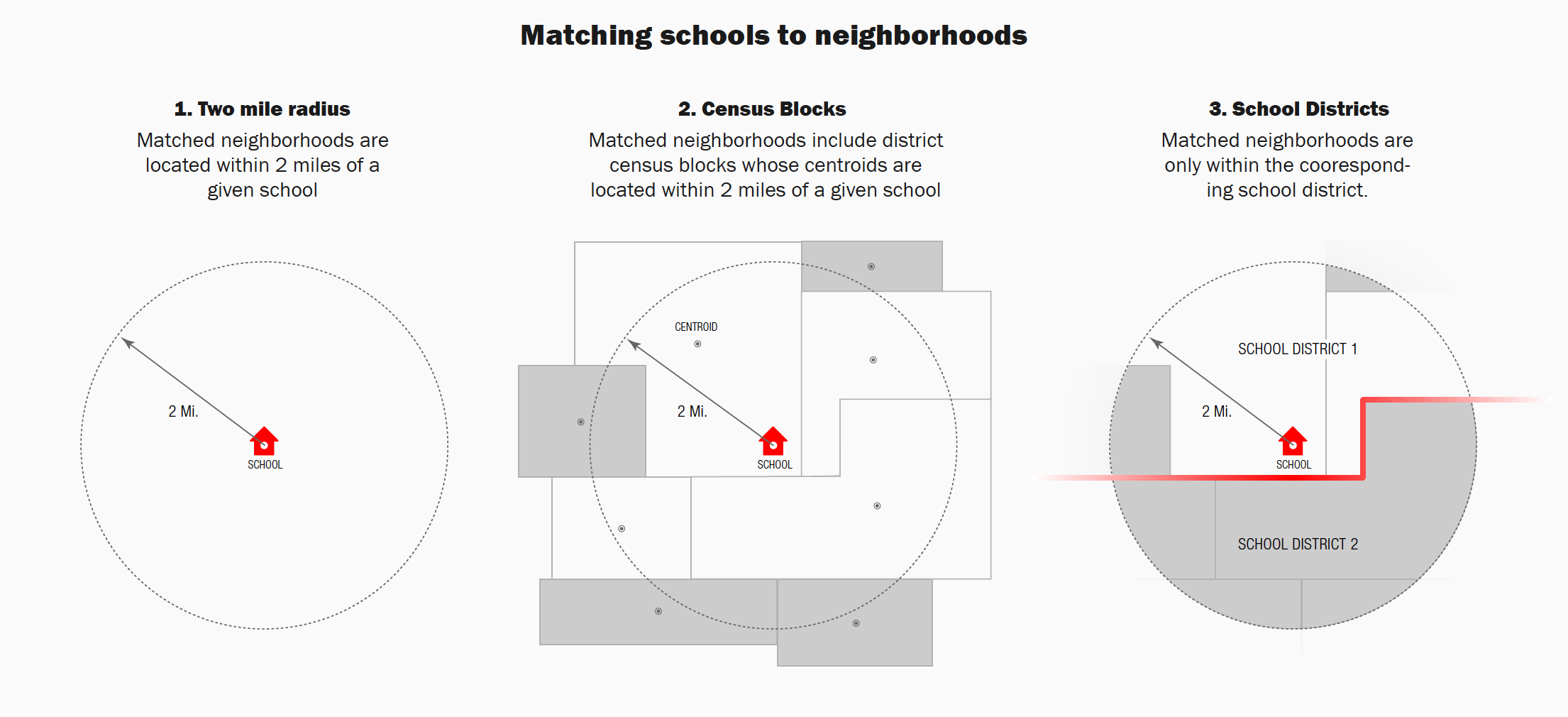
To better understand what it means to be an outlier, it helps to understand more about the methodology. First, the authors match school to neighborhoods like this:
SchoolSeg_Explainer_withType


Then they determined whether a school is an outlier for each racial category (white, black, Hispanic) based on the degree to which the racial imbalance between a school and its neighborhood is substantially outside its own state’s pattern of school-neighborhood differences, assuming a normal distribution.
This means there are some schools—in Washington, D.C. or Mississippi, for instance—where the black or white student populations are underrepresented or overrepresented by as much as 30 percent compared to their neighborhoods, but aren’t classified as an outlier. That’s because the threshold for determining outliers varies by state, and some states or districts—like D.C. or Mississippi—have higher thresholds because the state’s range of imbalance scores is wider.

Charters show more racial imbalance, especially in terms of their black student populations. But why?

Charter schools tend to have an overrepresentation of black students compared to their surrounding neighborhoods. In contrast, Hispanics are underrepresented in charter schools. So why is this? The most obvious explanation is that charters allow students to attend schools outside of their neighborhoods. But as the authors argue, it’s a bit more complicated than that.
The authors find no substantial correlation between the quality of statewide charter school laws and racial imbalance. At the same time, they don’t find anything beyond a modest correlational relationship between the degree to which charter schools may act as substitutes to traditional public schools (based off of geographic proximity) and charter school racial imbalance.

Schools in some states show more racial imbalance than others

There is also significant state-level variation in the racial imbalance of schools. In the regions with higher minority concentration, the South (for black Americans) and the West (for Hispanic Americans), the chances of seeing larger racial imbalances in public schools increases.
ES_20171117_Racial_Imbalances_By_State
The authors aren’t able to conclude whether this is because more minority density translates into more opportunity for minority populations to freely form more homogenous schools or because it translates into increased propensity for white-flight from the school system.

School district boundaries divide some communities along racial lines

For some school districts across the country, the way district lines have been drawn masks the extent to which schools don’t look like their surrounding neighborhoods in terms of race.
In Long Island, for example, school districts are quite small (the island is 1,400 square miles and has 125 districts, with the typical district having only one high school). When the authors relax the boundaries of their analysis and ignore district lines (incorporating schools outside of the school district, but within the 2-mile neighborhood radius), they find the racial imbalance in some of these “gerrymandered” school districts grows dramatically.
For more on how gerrymandered districts affect the racial makeup of some U.S. schools, read more on the Social Mobility Memos blog.

Conclusion

School-level data on racial imbalances can be valuable for a number of reasons, especially for local policymakers trying to understand the effect their policies may have on the racial makeup of local schools. Many localities such as Wake County, Boston, Charlotte, and Seattle have ended or substantially curtailed their efforts at K-12 school integration. Since 2000, at least 71 communities across the country have attempted to create new, smaller school districts (47 have been successful). Some fear such action could lead to greater segregation in public schools.
The authors emphasize caution, however, against drawing overly broad conclusions. The fact a school is more black than its surrounding neighborhood may be the result of intentional policy and is not necessarily good or bad. And when it comes to charters, the authors find it’s equally likely that they could lead to a deepening of segregation (in part by allowing for black students and white students to choose schools in which students of their race dominate enrollment) or they could reduce it and lead to greater equity (by loosening the connection between neighborhood and school).
The authors conclude that though recent history has seen a decrease in policy to encourage integration, it’s still possible to increase school diversity.
“The variation in the racial composition of schools across different districts shows that it is possible to increase integration. But it is important to be aware that this will be challenging given such high levels (still) of residential racial segregation, area based attendance policies, and a natural preference of many parents to send their children to a nearby school. Schools make the degree of residential segregation highly visible. School segregation is a symptom of residential segregation; which lies outside the scope of this paper.”

Wednesday, July 12, 2017

Taking a Different Approach to Inequality

NYT 4/30/17: S Mullainathan

Most Americans view current levels of economic inequality as a problem: In fact, for 30 years, Gallup polls have consistently found a clear majority supporting a more even distribution of wealth and income.
But there is far less agreement on how to achieve that goal. Do we need to level the playing field so that people born to modest circumstances have a better chance? Should we be trying to instill a stronger work ethic in the United States, and build a more robust culture of hard work? Counterproductive and, at times, bitter arguments bog down the search for solutions.
A recent paper by the psychologists Shai Davidai of the New School of Social Research and Thomas Gilovich of Cornell University reveals a quirk in human psychology that, I think, is responsible for some of our failure to make much progress on those issues. Understanding that quirk could help us find common ground on how to help the poorest Americans.
In public talks, Mr. Gilovich illustrates the research findings by This bias is embedded in our day-to-day lives. Most of our time and energy goes toward overcoming the challenges immediately in front of us. Headwinds demand attention because they must be overcome. Tailwinds may evoke a momentary sense of well-being and gratitude; but primarily, they free us to focus elsewhere, on challenges that must be overcome.
Mr. Davidai and Mr. Gilovich show some of the broader social and political consequences of this psychological asymmetry. They find, for example, that both Democrats and Republicans believe that electoral maps are not apportioned to their advantage. The scholars also find that, within families, people tend to think their parents were tougher on them than their siblings recognize.
Of course, we don’t really know what is going on inside everyone’s mind, but it does appear that many of us overrepresent the obstacles we face.
In many autobiographies, for example, even fortunate people, born to rich, loving families, look back on life and remember all the things that stood in their way. Not only do we play the starring role in our own life stories, but those stories often revolve around struggle.
I see this tendency in myself. When it comes to education, I have won not just one but several birth lotteries: Many children born next to me in rural India struggled to obtain anything beyond simple primary education and maybe a decent high school. Yet I had some of the best educational resources placed right in front of me all the way through my doctorate at Harvard.
I would be foolish if I did not remind myself of these advantages every day. Yet it is telling that I do need to remind myself. My spontaneous thoughts are of the challenges I faced, not the advantages I had.
This cognitive bias, I think, sheds light on persistent disagreements over inequality and opportunity that affect many of us in American society.
When we see our own past in terms of the headwinds we managed to overcome, it is easy to attribute the failure of others to a lack of perseverance. When poor children drop out of high school, someone who complains that these children don’t have an adequate work ethic may be remembering educational hurdles that she managed to surmount early in her own life.
We often disagree over the source of our success: Those who emphasize the existence of birth lotteries point to the easy ride the well-off have had. Yet relatively privileged people may look at their own lives and feel, “I’ve struggled too.”
Arguing about these perceptions doesn’t seem to be productive. We may try a different approach. Poverty, after all, is not only caused by strong headwinds; it is also characterized by a lack of tailwinds. If we work on creating more tailwinds — by giving poor children more advantages — we can solve many otherwise intractable problems.
Consider that by high school, poor children are doing much worse than those from well-off families. Researchers have found that most of this gap accumulates not during the school year, but in the summer months. In Baltimore, for example, a study has found that the entire achievement gap between the poor and the well-off is accounted for by learning disparities in the summer.
During these months, richer children benefit from summer programs and books around the house, and, more broadly, from the myriad advantages of having parents with the resources, knowledge and time to intellectually engage them. Even conversation around the dinner table can be a tailwind.
Closing the achievement gap could, then, be about generating tailwinds for poor children. In many ways, the provision of decent public education is itself a tailwind; it is, if not a complete equalizer, more equal than home life. But we could do more. For example, some have suggested the creation of a Summer Opportunity Scholarship to help low-income youth.
From a public policy perspective, it may be easier to agree on creating tailwinds than on removing headwinds. Even people who take great pride in having gotten ahead through hard work can, if prompted and upon reflection, recognize the tailwinds that helped them. This recognition does not detract from their genuine effort. Instead, it can be a moment to be thankful, perhaps for a family member who believed in you, or an unexpected piece of good fortune at just the right time.
By focusing on tailwinds, we can sidestep potential disagreements about the role of personal responsibility and initiative. Even with a tailwind, hard work is still needed; that work just yields more reward. A summer scholarship is not a substitute for serious effort.
We could garner support for such programs by asking people to remember the tailwinds in their past: It is a small step from gratitude for one’s blessings to the realization that everyone can use a little help, the poor most of all.
Sendhil Mullainathan is a professor of economics at Harvard. Follow him on Twitter at @m_sendhil.

Tuesday, April 18, 2017

Black and Proud. Even if Strangers Can’t Tell.

Black and Proud. Even if Strangers Can’t Tell. 


By REBECCA CARROLL
APRIL 1, 2017

My 11-year-old is understated, but not shy. He likes to bake, loves video games, is loyal to his friends and, biased as I may be, is a pretty good-looking kid. He gets mad sometimes, though, that people don’t immediately register him as black. “You’re so lucky,” he said to me a few months ago. “People look at you and know that you are black.”

Being black in America has historically been determined by whether or not you look black to nonblack people. This keeps racism operational. Brown and black skin in this country can invite a broad and freewheeling range of bad behavior — from job discrimination to a child being shot dead in the street. For my son, though, being black in America is about more than his skin color. It’s about power, confidence, culture and belonging.

You inherit race, though. You don’t steal it. We’re reminded of this once again by Rachel Dolezal, the white woman who made national headlines in 2015 for claiming a black identity because she felt like it. She released a memoir last week.

For the record, Ms. Dolezal, who has legally changed her name to Nkechi Amare Diallo, is white. She is the biological child of white parents who have stated publicly that their daughter is a white woman falsely identifying as black.

Ms. Dolezal’s story demonstrates our unnerving trajectory from 2015, when white privilege was a zeitgeisty phrase people might apply to certain egregious behavior — like using your white privilege to decide you are black because you feel an affinity for corn rows and weaves — to the white supremacy of the Trump administration.

I was adopted into a white family, and the only black birth-family members I am aware of are no longer living. Every day I am saddened by the fact that I don’t have any black relatives for my son to know and spend time with. But my son has me, and I have him. And we are black. He also has his father, my husband, a white man of Italian descent, which accounts for our son’s light-skinned appearance.

My son is not the only light-skinned, mixed or biracial person I know who identifies primarily as black. Increasingly, I have observed my adult peers and colleagues who fall into this category not merely identifying as black, but routinely pulling out the receipts to prove their blackness.

Some of this may have to do with what the brilliant Jordan Peele, who is also biracial and black, tapped into for the plot of his genre-redefining box office hit, “Get Out” — that it’s cool to be black right now, that we are trending.

In the more than two years since Michael Brown was fatally shot by police in Ferguson, Mo., and the city erupted in anger and unrest, increasing the visibility of the Black Lives Matter movement, we have borne witness to the very best of who we are as black people in this country. The atrocities continue — the glaring police brutality, the staggeringly disproportionate numbers of black men in the prison system, the racial wage gap and any number of other disparities that come along with a nation founded upon enslavement of nonwhite people — but we galvanize our grief.

Our new president campaigned directly to those white people who are terrified by our resolve to not merely survive, but to represent America as something other than demoralized chattel. President Trump can try to reduce us to “the blacks” who are all relegated to life in the “inner cities,” which “are a disaster education-wise, job-wise, safety-wise, in every way possible,” but I suspect that’s because he knows he has already lost control of the narrative.

In the 1970s Warner, N.H., then a town with a population under 1,500, where census data indicates that I represented the black population in its entirety, I used to love watching “The Wiz.” I could look at Diana Ross as Dorothy, with her chic round Afro, brown skin and ruby slippers, and Michael Jackson, whimsical and fluid as the Scarecrow — the part I eventually got to play in my dance class production of the show — all day.

In middle school, I spent a lot of time trying to explain to my white classmates that even though I look black, I am actually biracial — my birth mother is white and my birth father is black — and so I wasn’t really as black as they thought. What’s more, my adolescent logic went, my adopted parents are white, so that should count for something, right? People were seldom interested. At best, I heard this: “We don’t even think of you as black anyway.”

It was a comment that, based on how I thought then, should have made me feel better than it did. After all, wasn’t that what I wanted? To be considered an equal? It took me a long time before I understood that being an equal in an exclusively white environment meant erasing and devaluing my blackness. As a young adult, though, I did come to realize that wholly embracing my blackness, not explaining it away to classmates or friends, comes with a mighty and magnificent sense of joy, which I hope will serve as a model for my son to keep doing the same.

So it’s profound to me that my light-skinned son, who identifies as both mixed and black, was upset when he started sixth grade last fall at a new school where his new racially diverse peer group expressed confusion about his background.

When my son first started to black identify at about 5 or 6 years old, an acquaintance of ours asked my husband, in my presence, if he felt like we were “depriving” our son of his “white side.” My husband, a sociology professor and the author of two books on the failure of housing and school desegregation in the United States, said: “If my parents had instilled any Italian culture in me, I might want to share that with my son. But if you’re talking about general whiteness, there’s nothing there to pass down.”

This acquaintance, it seemed, was suggesting that by encouraging our son to embrace his blackness, we were depriving him of something bigger and greater than the already big and great benefit of white privilege. That my son sees more power in centering his blackness over exploiting whatever white privilege he may ultimately be afforded is a thing of glory.

Tuesday, April 11, 2017

Who Needs Charters When You Have Public Schools Like These?

Who Needs Charters When You Have Public Schools Like These?

By David L. Kirp

Published April 1, 2017
NY Times

TULSA, Okla. — The class assignment: Design an iPad video game. For the player to win, a cow must cross a two-lane highway, dodging constant traffic. If she makes it, the sound of clapping is heard; if she’s hit by a car, the game says, “Aw.” 

“Let me show you my notebook where I wrote the algorithm. An algorithm is like a recipe,” Leila, one of the students in the class, explained to the school official who described the scene to me.

You might assume these were gifted students at an elite school. Instead they were 7-year-olds, second graders in the Union Public Schools district in the eastern part of Tulsa, Okla., where more than a third of the students are Latino, many of them English language learners, and 70 percent receive free or reduced-price lunch. From kindergarten through high school, they get a state-of-the-art education in science, technology, engineering and math, the STEM subjects. When they’re in high school, these students will design web pages and mobile apps, as well as tackle cybersecurity and artificial intelligence projects. And STEM-for-all is only one of the eye-opening opportunities in this district of around 16,000 students.

Betsy DeVos, book your plane ticket now.

Ms. DeVos, the new secretary of education, dismisses public schools as too slow-moving and difficult to reform. She’s calling for the expansion of supposedly nimbler charters and vouchers that enable parents to send their children to private or parochial schools. But Union shows what can be achieved when a public school system takes the time to invest in a culture of high expectations, recruit top-flight professionals and develop ties between schools and the community.

Union has accomplished all this despite operating on a miserly budget. Oklahoma has the dubious distinction of being first in the nation in cutting funds for education, three years running, and Union spends just $7,605 a year in state and local funds on each student. That’s about a third less than the national average; New York State spends three times more. Although contributions from the community modestly augment the budget, a Union teacher with two decades’ experience and a doctorate earns less than $50,000. Her counterpart in Scarsdale, N.Y., earns more than $120,000.

“Our motto is: ‘We are here for all the kids,’ ” Cathy Burden, who retired in 2013 after 19 years as superintendent, told me. That’s not just a feel-good slogan. “About a decade ago I called a special principals’ meeting — the schools were closed that day because of an ice storm — and ran down the list of student dropouts, name by name,” she said. “No one knew the story of any kid on that list. It was humiliating — we hadn’t done our job.” It was also a wake-up call. “Since then,” she adds, “we tell the students, ‘We’re going to be the parent who shows you how you can go to college.’ ”

Last summer, Kirt Hartzler, the current superintendent, tracked down 64 seniors who had been on track to graduate but dropped out. He persuaded almost all of them to complete their coursework. “Too many educators give up on kids,” he told me. “They think that if an 18-year-old doesn’t have a diploma, he’s got to figure things out for himself. I hate that mind-set.”

This individual attention has paid off, as Union has defied the demographic odds. In 2016, the district had a high school graduation rate of 89 percent — 15 percentage points more than in 2007, when the community was wealthier, and 7 percentage points higher than the national average.

The school district also realized, as Ms. Burden put it, that “focusing entirely on academics wasn’t enough, especially for poor kids.” Beginning in 2004, Union started revamping its schools into what are generally known as community schools. These schools open early, so parents can drop off their kids on their way to work, and stay open late and during summers. They offer students the cornucopia of activities — art, music, science, sports, tutoring — that middle-class families routinely provide. They operate as neighborhood hubs, providing families with access to a health care clinic in the school or nearby; connecting parents to job-training opportunities; delivering clothing, food, furniture and bikes; and enabling teenage mothers to graduate by offering day care for their infants.

Two fifth graders guided me around one of these community schools, Christa McAuliffe Elementary, a sprawling brick building surrounded by acres of athletic fields. It was more than an hour after the school day ended, but the building buzzed, with choir practice, art classes, a soccer club, a student newspaper (the editors interviewed me) and a garden where students were growing corn and radishes. Tony, one of my young guides, performed in a folk dance troupe. The walls were festooned with family photos under a banner that said, “We Are All Family.”

This environment reaps big dividends — attendance and test scores have soared in the community schools, while suspensions have plummeted.

The district’s investment in science and math has paid off, too. According to Emily Lim, who runs Union’s STEM program, the district felt it was imperative to offer STEM classes to all students, not just those deemed gifted.

In one class, I watched eighth graders create an orthotic brace for a child with cerebral palsy. The specs: The toe must be able to rise but cannot fall. Using software that’s the industry standard, 20 students came up with designs and then plaster of Paris models of the brace.

“It’s not unusual for students struggling in other subjects to find themselves in the STEM classes,” Ms. Lim said. “Teachers are seeing kids who don’t regard themselves as good readers back into reading because they care about the topic.”

A fourth grader at Rosa Parks Elementary who had trouble reading and writing, for example, felt like a failure and sometimes vented his frustration with his fists. But he’s thriving in the STEM class. When the class designed vehicles to safely transport an egg, he went further than anybody else by giving his car doors that opened upward, turning it into a little Lamborghini. Such small victories have changed the way he behaves in class, his teacher said — he works harder and acts out much less.

Superintendents and school boards often lust after the quick fix. The average urban school chief lasts around three years, and there’s no shortage of shamans promising to “disrupt” the status quo.

The truth is that school systems improve not through flash and dazzle but by linking talented teachers, a challenging curriculum and engaged students. This is Union’s not-so-secret sauce: Start out with an academically solid foundation, then look for ways to keep getting better.

Union’s model begins with high-quality prekindergarten, which enrolls almost 80 percent of the 4-year-olds in the district. And it ends at the high school, which combines a collegiate atmosphere — lecture halls, student lounges and a cafeteria with nine food stations that dish up meals like fish tacos and pasta puttanesca — with the one-on-one attention that characterizes the district.

Counselors work with the same students throughout high school, and because they know their students well, they can guide them through their next steps. For many, going to community college can be a leap into anonymity, and they flounder — the three-year graduation rate at Tulsa Community College, typical of most urban community colleges, is a miserable 14 percent. But Union’s college-in-high-school initiative enables students to start earning community college credits before they graduate, giving them a leg up.

The evidence-based pregnancy-prevention program doesn’t lecture adolescents about chastity. Instead, by demonstrating that they have a real shot at success, it enables them to envision a future in which teenage pregnancy has no part.

“None of this happened overnight,” Ms. Burden recalled. “We were very intentional — we started with a prototype program, like community schools, tested it out and gradually expanded it. The model was organic — it grew because it was the right thing to do.”

Building relationships between students and teachers also takes time. “The curriculum can wait,” Lisa Witcher, the head of secondary education for Union, told the high school’s faculty last fall. “Chemistry and English will come — during the first week your job is to let your students know you care about them.”

That message resonated with Ms. Lim, who left a job at the University of Oklahoma-Tulsa School of Community Medicine and took a sizable pay cut to work for Union. “I measure how I’m doing by whether a girl who has been kicked out of her house by her mom’s boyfriend trusts me enough to tell me she needs a place to live,” she told me. “Union says, ‘We can step up and help.’ ”

Under the radar, from Union City, N.J., and Montgomery County, Md., to Long Beach and Gardena, Calif., school systems with sizable numbers of students from poor families are doing great work. These ordinary districts took the time they needed to lay the groundwork for extraordinary results.

Will Ms. DeVos and her education department appreciate the value of investing in high-quality public education and spread the word about school systems like Union? Or will the choice-and-vouchers ideology upstage the evidence?


David L. Kirp is a professor at the University of California, Berkeley, a senior fellow at the Learning Policy Institute and a contributing opinion writer.

Thursday, March 23, 2017

Ta-Nehisi Coates- Between The World And Me


Below is the link to and excerpt from Ta-Nehisi Coates book Between The World And Me.

https://www.youtube.com/watch?v=L7wFZTgSFt0


Tuesday, November 15, 2016

Teaching Young Children About Race

Teaching Young Children about Race
A Guide for Parents and Teachers
By Louise Derman-Sparks and Julie Olsen Edwards
(Originally posted July 8th, 2015)

            Adults sometimes ask:  Aren’t prejudice, discrimination, and anti-bias adult issues? Why bring children into it? In one sense, these are adult issues. Adults have the power to create, to teach, to maintain bias—and to eliminate it. In another sense, because the realities of prejudice and discrimination begin to affect children’s development early, it is developmentally appropriate to address them in our work with young children.
            Young children need caring adults to help them construct a positive sense of self and a respectful understanding of others. They need adults to help them begin to navigate and resist the harmful impact of prejudice and discrimination. A person’s early childhood years lay the foundation for a developmental and experiential journey that continues into adulthood. With appropriate adult guidance, this foundation will be a strong one, providing the base for the next stages of healthy development and the skills a person needs to thrive and succeed in a complex, diverse world.
            Anti-bias education is an integral part of the “bricks and mortar” of emotional well-being and social competence, as well as an emotional foundation upon which children fully develop their cognitive capacities. A healthy sense of self requires that children know and like who they are without feeling superior to others. Understanding and liking one’s own personal and social identities open up the possibilities of building caring connections with others. Thinking critically about stereotypes, prejudice, and discrimination takes away barriers to comfortable and respectful interactions with a wide range of people and gives children a tool to resist negative messages about their identities. Strong cognitive development is also enhanced when children develop curiosity, openness to multiple perspectives, and critical-thinking skills.

Strategies for learning about physical differences and similarities
            Creating a rich anti-bias learning environment sets the stage for discussion and activities about racial and other physical differences and similarities. The richer the environment, the more likely children will ask questions, even in classrooms where the staff and children come from similar racial backgrounds.
In all activities, highlight that physical diversity among people is desirable, and that all colors, shades, and shapes of people are beautiful. Talk about differences in a tone of delight and interest. Create a vocabulary that encourages children to look at themselves and others and admire their sameness and their uniqueness. Just as we do not wait until a child asks questions about how to read before planning how to provide a range of literacy learning opportunities, anti-bias education is the teacher’s responsibility, not the child’s, to initiate.
            Caution—Never single out one specific child when you do activities about the physical characteristics linked to racial identity. Every activity should be about all of the children, as everyone has a racial identity. Moreover, doing activities about all children reinforces that differences and similarities can be found within each racial identity group as well as across groups.
·         Exploring skin color, hair, and eyes
Children are active observers of physical characteristics. As they become familiar with some of their own features and those of their classmates, help them to have vocabulary and ideas to understand sameness and difference. There are many ways to involve children in discovering similarities and differences among themselves, their teachers, and their families.
·         Focus on children’s confusion about their own skin color
If, when you invite the children to make self-portraits, a child chooses colors that do not correspond to his actual skin, eye, or hair coloring, consider gently encouraging the child to choose the color closest to his skin color.
·         Expanding awareness of racial similarities and differences
After helping children become aware that the people within their family are alike and different, it is important to expand their knowledge and awareness to groups of people beyond those in the classroom and neighborhood. As children grow, they move into ever wider and more diverse settings, and we want them to be open to and respectful of all kinds of people they may encounter.
Fostering critical thinking and respectful relationships
            Positive and accurate learning experiences about human differences and similarities help to give children a foundation for resisting incorrect and harmful messages about themselves and others. Preschoolers are ready to begin thinking critically about the accuracy and fairness of the information and images they encounter. They also have the capacity to use their developing empathy to understand that unfair behavior hurts people and can learn respectful ways of interacting with others. Teachers can use the following strategies to promote young children’s development of these understandings and competencies.
·         Cultivate children’s empathy and ways to deal with the hurt of stereotyping. Read books that depict children experiencing unfair treatment based on their racial identity.
·         Tell persona doll stories about a discriminatory incident between dolls, engaging children’s empathy and problem-solving skills.
·         Intentionally plan activities to counter potential over generalizations or existing stereotypes in the children’s general environment.
·         Support children as they demonstrate awareness of stereotyping.
·         Engage children in group action. It is empowering when we help children take something that is “unfair” into something “fair.” Sometimes this involves addressing personal conflict, helping a child speak up for another child. But it is particularly powerful when children act together.
            If we want children to thrive in a diverse world and choose to stand up for themselves and others, then we must choose to help young children make sense out of the confusing and often emotionally charged messages they receive about themselves and others. The commitment to support each child to develop pride and self-confidence and deep connections with others calls on us to foster all children’s healthy racial identity. When we give children language to discuss their identities in an atmosphere of interest and delight, and the tools for addressing the unfairness they will inevitably encounter, then we know we have helped children construct a strong foundation for the next phases of their lives.

http://www.teachingforchange.org/teaching-about-race