Monday, April 30, 2018

How our education system undermines gender equity

How our education system undermines gender equity

How our education system undermines gender equity And why culture change—not policy—may be the solution 

Joseph Cimpian, Monday, April 23, 2018 

There are well-documented achievement and opportunity gaps by income and race/ethnicity. K-12 accountability policies often have a stated goal of reducing or eliminating those gaps, though with questionable effectiveness. Those same accountability policies require reporting academic proficiency by gender, but there are no explicit goals of reducing gender gaps and no “hard accountability” sanctions tied to gender-subgroup performance. We could ask, “Should gender be included more strongly in accountability policies?”

In this post, I’ll explain why I don’t think accountability policy interventions would produce real gender equity in the current system—a system that largely relies on existing state standardized tests of math and English language arts to gauge equity. I’ll argue that although much of the recent research on gender equity from kindergarten through postgraduate education uses math or STEM parity as a measure of equity, the overall picture related to gender equity is of an education system that devalues young women’s contributions and underestimates young women’s intellectual abilities more broadly.

In a sense, math and STEM outcomes simply afford insights into a deeper, more systemic problem. In order to improve access and equity across gender lines from kindergarten through the workforce, we need considerably more social-questioning and self-assessment of biases about women’s abilities.

As soon as girls enter school, they are underestimated
For over a decade now, I have studied gender achievement with my colleague Sarah Lubienski, a professor of math education at Indiana University-Bloomington. In a series of studies using data from both the 1998-99 and 2010-11 kindergarten cohorts of the nationally representative Early Childhood Longitudinal Study, we found that no average gender gap in math test scores existed when boys and girls entered kindergarten, but a gap of nearly 0.25 standard deviations developed in favor of the boys by around second or third grade.

For comparison purposes, the growth of the black-white math test score gap was virtually identical to the growth in the gender gap. Unlike levels and growth in race-based gaps, though, which have been largely attributed to a combination of differences in the schools attended by black and white students and to socio-economic differences, boys and girls for the most part attend the same schools and come from families of similar socio-economic status. This suggests that something may be occurring within schools that contributes to an advantage for boys in math.

Exploring deeper, we found that the beliefs that teachers have about student ability might contribute signiæcantly to the gap. When faced with a boy and a girl of the same race and socio-economic status who performed equally well on math tests and whom the teacher rated equally well in behaving and engaging with school, the teacher rated the boy as more mathematically able—an alarming pattern that replicated in a separate data set collected over a decade later.

Another way of thinking of this is that in order for a girl to be rated as mathematically capable as her male classmate, she not only needed to perform as well as him on a psychometrically rigorous external test, but also be seen as working harder than him. Subsequent matching and instrumental variables analyses suggested that teachers’ underrating of girls from kindergarten through third grade accounts for about half of the gender achievement gap growth in math. In other words, if teachers didn’t think their female students were less capable, the gender gap in math might be substantially smaller.

An interaction that Sarah and I had with a teacher drove home the importance and real-world relevance of these results. About five years ago, while Sarah and I were faculty at the University of Illinois, we gathered a small group of elementary teachers together to help us think through these findings and how we could intervene on the notion that girls were innately less capable than boys. One of the teachers pulled a stack of papers out of her tote bag, and spreading them on the conference table, said, “Now, I don’t even understand why you’re looking at girls’ math achievement. These are my students’ standardized test scores, and there are absolutely no gender differences. See, the girls can do just as well as the boys if they work hard enough.” Then, without anyone reacting, it was as if a light bulb went on. She gasped and continued, “Oh my gosh, I just did exactly what you said teachers are doing,” which is attributing girls’ success in math to hard work while attributing boys’ success to innate ability. She concluded, “I see now why you’re studying this.”

Although this teacher did ultimately recognize her gender-based attribution, there are (at least) three important points worth noting. First, her default assumption was that girls needed to work harder in order to achieve comparably to boys in math, and this reflects an all-too-common pattern among elementary school teachers, across at least the past couple decades and in other cultural contexts. Second, it is not obvious how to get teachers to change that default assumption. Third, the evidence that she brought to the table was state standardized test scores, and these types of tests can reveal different (often null or smaller) gender achievement gaps than other measures.

On this last point, state standardized tests consistently show small or no differences between boys and girls in math achievement, which contrasts with somewhat larger gaps on NAEP and PISA, as well as with gaps at the top of the distribution on the ECLS, SAT Mathematics assessment, and the American Mathematics Competition. The reasons for these discrepancies are not entirely clear, but what is clear is that there is no reason to expect that “hardening” the role of gender in accountability policies that use existing state tests and current benchmarks will change the current state of gender gaps. Policymakers might consider implementing test measures similar to those where gaps have been noted and placing more emphasis on gains throughout the achievement distribution. However, I doubt that a more nuanced policy for assessing math gains would address the underlying problem of the year-after-year underestimation of girls’ abilities and various signals and beliefs that buttress boys’ confidence and devalue girls, all of which cumulatively contributes to any measured gaps.

More obstacles await women in higher education and beyond 
Looking beyond K-12 education, there is mounting evidence at the college and postgraduate levels that cultural differences between academic disciplines may be driving women away from STEM fields, as well as away from some non-STEM fields (e.g., criminal justice, philosophy, and economics). In fact, although research and policy discussions often dichotomize academic fields and occupations as “STEM” and “non-STEM,” the emerging research on gender discrimination in higher education finds that the factors that drive women away from some fields cut across the STEM/non-STEM divide. Thus, while gender representation disparities between STEM and non-STEM fields may help draw attention to gender representation more broadly, reifying the STEM/non-STEM distinction and focusing on math may be counterproductive to understanding the underlying reasons for gender representation gaps across academic disciplines.

In a recent study, my colleagues and I examined how perceptions on college majors relate to who is entering those majors. We found that the dominant factor predicting the gender of college-major entrants is the degree of perceived discrimination against women. To reach this conclusion, we used two sources of data. First, we created and administered surveys to gather perceptions on how much math is required for a major, how much science is required, how creative a field is, how lucrative careers are in a field, how helpful the field is to society, and how difficult it is for a woman to succeed in the field. After creating factor scales on each of the six dimensions for each major, we mapped those ratings onto the second data source, the Education Longitudinal Study, which contains several prior achievement, demographic, and attitudinal measures on which we matched young men and women attending four-year colleges.

Among this nationally representative sample, we found that the degree to which a field was perceived to be math- or science-intensive had very little relation to student gender. However, fields that were perceived to discriminate against women were strongly predictive of the gender of the students in the field, whether or not we accounted for the other five traits of the college majors. In short, women are less likely to enter fields where they expect to encounter discrimination.


And what happens if a woman perseveres in obtaining a college degree in a field where she encounters discrimination and underestimation and wants to pursue a postgraduate degree in that field, and maybe eventually work in academia? The literature suggests additional obstacles await her. These obstacles may take the form of those in the field thinking she’s not brilliant like her male peers in graduate school, having her looks discussed on online job boards when she’s job-hunting, performing more service work if she becomes university faculty, and getting less credit for co-authored publications in some disciplines when she goes up for tenure.

Each of the examples here and throughout this post reflects a similar problem—education systems (and society) unjustifiably and systematically view women as less intellectually capable.

Societal changes are necessary

My argument that policy probably isn’t the solution is not intended to undercut the importance of affirmative action and grievance policies that have helped many individuals take appropriate legal recourse. Rather, I am arguing that those policies are certainly not enough, and that the typical K-12 policy mechanisms will likely have no real effect in improving equity for girls. The obstacles that women face are largely societal and cultural. They act against women from the time they enter kindergarten—instilling in very young girls a belief they are less innately talented than their male peers—and persist into their work lives. Educational institutions—with undoubtedly many well-intentioned educators—are themselves complicit in reinforcing the hurdles. In order to dismantle these barriers, we likely need educators at all levels of education to examine their own biases and stereotypes.

Tuesday, February 6, 2018

The Intersection of Black Lives matter and Adult Education: One Community College Initiative

 
Black Lives Matter: Toward a Modern Practice of Mass Struggle
Born as a Twitter hashtag, Black Lives Matter has evolved into a potent alternative to the political paralysis and isolation that racial jus­tice proponents have faced since the election of Obama. In just over two years, the young move­ment has reinvigorated confrontation politics, giving voice to a popular and righteous rage, establishing a new touchstone of grassroots resistance, and ending the acquiescence that has crippled progressive forces in the age of Obama. The upsurge, which has centered on the crucial, galvanizing issue of police misconduct, also shows signs of addressing larger questions of social inequity. With continued momentum, Black Lives Matter may help reverse the coun­teroffensive against workers and people of color that has defined the long aftermath of the 1960s and 1970s liberation struggles.1 To sur­pass the relatively ephemeral accomplishments of precursors such as Occupy Wall Street, how­ever, the emerging movement must draw on and modernize the creative traditions of popu­lar insurgency. It must become a sustained, truly mass struggle, confronting ferocious backlash and overcoming multiple challenges while developing its considerable strengths.
Black Lives Matter began, quite modestly, as #BlackLivesMatter. The hashtag was created in 2013 by Patrice Cullors, Alicia Garza, and Opal Tometi—California and New York-based organizers active in incarceration, immigration, and domestic labor campaigns—after the acquittal of George Zimmerman for the murder in Florida of seventeen-year-old Trayvon Martin. The slogan’s deeper significance as the rallying cry for an incipient movement crystal­lized in 2014 during the Ferguson, Missouri uprisings against police brutality. In the words of activists, the hashtag leapt from social media “into the streets.” Black Lives Matter, which Garza has called “a love note” to black com­munities, now serves as shorthand for diverse organizing efforts—both sporadic and sus­tained—across the country. The most recogniz­able expression of widespread black outrage against police aggression and racist violence, the phrase has engendered a spirited, if decen­tralized, movement.
Birth of a Contemporary Human Rights Movement
The variety of local campaigns associated with Black Lives Matter confounds attempts to por­tray the movement in fine detail. Still, the con­tours of a modern human rights struggle are discernible. Black Lives Matter is youthful, though it has reenergized older activists who are eager to connect with a new generation of organizers. It arises from an organic black pro­test tradition, while drawing impassioned par­ticipants of all colors. Its leadership departs sharply from the model of the singular, charis­matic clergyman or politician. Founded by black women, two of whom are queer, the movement has galvanized an array of grass-roots activists in multiple communities. Few are full-time organizers, though many have had encounters with racialized policing or other­wise are personally affected by mass incarcera­tion. Many are also feminist, LGBTQ, working-class or low-income, social media savvy, and streetwise. Like other members of the movement, they are waging an unpreten­tious, democratic, militant crusade, determined to remain autonomous both from the American political establishment and from old guard leaders, such as Jesse Jackson and Al Sharpton, seen as more invested in punditry than in popu­lar struggle.2
It is this commitment to independence and militancy that has shaped the tactics of the movement. Demanding accountability for rac­ist violence and an immediate end to the murder of black people at the hands of the state, Black Lives Matter activists have used a host of dis­ruptive techniques to advance their cause. Their mainstay has been occupation—of highways, intersections, sporting events, retail stores, malls, campaign events, police stations, and municipal buildings. They have organized “die­ins,” marches, and rallies in multiple cities, viewing creative disturbance as a means of dra­matizing routine attacks on black life.3 Tellingly, the mantra of such demonstrations has evolved from “Hands up, don’t shoot!” to the more emphatic “Shut it down!” Whether the move­ment categorically rejects—or simply mis­trusts—electoral politics remains unclear. What is evident is that most Black Lives Matter adherents recognize the inherent shortcomings of appeals to politicians, the courts, and other “acceptable” channels of redress, and have wholeheartedly embraced the arena of the street.
Political Tendencies within the Movement
This bold strategy has by no means stopped or even slowed the crescendo of violence. The achievements of Black Lives Matter are nevertheless striking. First, the movement has remained largely unfettered by “respectability politics,” the belief that subjugated groups can win support for their cause simply by adhering to conventional standards of decorum. As expo­nents of Black Lives Matter are keenly aware, rituals of propriety will not dignify dark skin that society as a whole detests and degrades. Movement participants have refused to engage in victim blaming. They have resisted dead-end narratives that emphasize “black-on-black crime” or that prescribe cultural rehabilitation while eschewing righteous dissent. (Such per­spectives reinforce the racist premise that black pathology—not white supremacy—is chiefly responsible for the state’s systematic assault on black people.)
They have amassed concrete victories, too. Scattered instances of police officers being charged and disciplined for misconduct suggest that popular outcry can help force concessions from even the most repressive system.4 The movement’s real success, however, lies in popu­larizing radical discourse and providing a vibrant model of democratic participation. As the move­ment’s founders have written,
When we say Black Lives Matter, we are
broadening the conversation around state
violence to include all of the ways in
which Black people are intentionally left
powerless at the hands of the state. We
are talking about the ways in which Black
lives are deprived of our basic human
rights and dignity . . . How Black women
bearing the burden of a relentless assault
on our children and our families is state
violence. How Black queer and trans
folks bear a unique burden from a hetero
­patriarchal society that disposes of us like
garbage and simultaneously fetishizes us
and profits off of us, and that is state
violence.5
Such rhetoric suggests that far-reaching change—not the mere amelioration of police abuse—is the objective.
Black Lives Matter’s elements of spontane­ity and self-organization reflect a grassroots surge rather than a measured and conciliatory airing of grievances. Although by no means consistent or complete, its attempts to center those closer to the margins—women, queer people, and various non-elites—through the production of blogs, reports, missives, and by simply invoking the names of unsung victims of police violence (“Say Her Name,” as a related campaign is dubbed), signal an ethos of inclusiveness and a desire for a fundamental rearrangement of power relations.
Similar traits have defined past social move­ments. One thinks immediately of the uncom­promising spirit of the civil rights–Black Power era, and particularly of the militancy of the Student Nonviolent Coordinating Committee (SNCC). Like Black Lives Matter participants, SNCC’s young members also belonged to a generation radicalized by a shocking, highly publicized murder—the 1955 killing of Emmett Till by southern racists. Other historical analo­gies may be drawn. The street insurrectionists (labeled “rioters”) of the 1960s in some ways anticipated modern activists who face milita­rized police in urban centers.
In the current generation of protests, one detects resonances of Black Power’s insistence on self-definition and human rights rather than on mere social inclusion. Of course, determination to preserve black life in the face of white suprem­acist violence has always been a radical principle, from the anti-lynching crusades of Ida B. Wells around the turn of the twentieth century, to the Negro Silent Protest Parade of 1917, to the pro­tests surrounding the Scottsboro Boys case of the 1930s, to the 1951 We Charge Genocide petition by the Civil Rights Congress, to the exertions of the Deacons for Defense and the Black Panthers at the peak of the postwar movement. What ani­mated these struggles—and those of countless leftist and labor causes—was their insurgent nature and the uncompromising character of their rank and file participants, traits that Black Lives Matter exemplifies.6
The Struggle for Racial Justice  in the Age of Obama
That said, calling “the movement for black lives” (a broad designation encompassing the many formations informally linked to Black Lives Matter) a “new civil rights movement” may obscure how dramatically the social land­scape has shifted in recent decades. If Obama’s presence in the White House symbolizes accep­tance by many Americans of the ideal of a mul­tiracial society, the modern era also has witnessed the construction of a mass incarcera­tion regime that viciously targets black commu­nities. Dominant conceptions of “race relations” posit interpersonal relations, or the visibility of black elites, as critical indexes of progress. Such measures obscure both the persistence of sys­temic racism and the extent to which racialized practices have fueled the explosive growth of the carceral state. Enforcing racial hierarchy has been a central task of policing since the days of slave patrols. Today, however, the criminal jus­tice system performs social control tasks—the regulation of black bodies, the harnessing of black surplus labor in the name of corporate profit—once fulfilled by Jim Crow segregation and other overt forms of discrimination.7
Ironically, the sheer scope and intrusiveness of the modern carceral state provide distinct opportunities for organizers. By confronting racist patterns of policing, Black Lives Matter is addressing a reality that touches the lives of a wide segment of people of color. Structural rac­ism in the post-segregation era generally has lacked unambiguous symbols of apartheid around which a popular movement could cohere. Yet mass incarceration and the tech­niques of racialized policing on which it depends—“broken windows,” stop-and-frisk, “predictive policing,” and other extreme forms of surveillance—have exposed the refurbished, but no less ruthless, framework of white supremacy. In poorer black and brown commu­nities, recognition that cops serve primarily to monitor and subjugate rather than “to serve and protect” has fostered both deep resentment and radical, oppositional consciousness.8
It has also created the potential for multira­cial, class-conscious movements. However, despite the emergence of Black Lives Matter offshoots such as “Native Lives Matter,” no national alliance of people of color has coalesced on the issue of police violence. More extensive collaboration with Latinos and undocumented populations—both groups that have participated in Black Lives Matter protests—would signal a major victory for the movement. For the moment, the relative diversity of many Black Lives Matter formations has yet to engender a consciously multiracial political surge from below, as in the “rainbow radicalism” that marked some phases of Black Power organizing during the 1960s and 1970s. Lingering intereth­nic tensions and divisions, as well as the bur­dens of daily economic survival, continue to militate against the rebirth of such an expansive “rights” consciousness and ethic of solidarity. The existing movement has drawn the backing of white leftists and certain student organiza­tions. Yet confrontations between Black Lives Matter proponents and presidential hopeful Bernie Sanders, in which activists interrupted campaign events to demand more robust engagement with questions of structural racism, have elicited deep hostility from some of the candidate’s supporters. Thankfully, such interventions have revived debate about the dynamics of race and class (and the role of white privilege) in American progressive politics.9
The relationship of Black Lives Matter to white working-class and poor people, who also face elevated rates of police abuse, remains unclear. The false universality of the assertion that “All Lives Matter” appeals to many white workers, especially those inclined to dismiss black claims in the name of a fictive post-racial ideal. However, racially diverse groups of workers, including active members of the Fight for $15 minimum wage campaign, have joined Black Lives Matter protests. (Collaboration between the movements has remained informal and fairly sporadic.) And although labor as a whole is split on the issue, some unions with large memberships of people of color have urged the AFL-CIO to withdraw its support for police unions, which often serve as mecha­nisms for suppressing civilian challenges to, and oversight of, law enforcement. The Service Employees International Union (SEIU) has issued statements of support for Black Lives Matter, but has yet to grant the movement the vigorous backing it has offered the Fight for $15 struggle. Complicating the relationship between labor and the movement for black lives is the reality that the livelihood of some work­ers (e.g., prison guards) depends on the carceral state. Ultimately, Black Lives Matter may help intensify the growing pressure on the contem­porary labor movement to revive its social jus­tice roots. As a whole, however, Black Lives Matter activists have largely neglected to engage progressive trade unionism or to iden­tify labor as a major ally.10
Internal Divergences and External Threats
Even as it contemplates external alliances, Black Lives Matter is grappling with its own internal tensions. The movement has avoided ties to mainstream electoral politics, which has long been a barren realm for the pursuit of gen­uinely progressive visions of transformation. Upon learning of their formal endorsement by the Democratic Party last fall, Black Lives Matter organizers promptly repudiated the statement of support and reaffirmed their com­mitment to autonomy. Yet elements within the movement (thus far not organized as distinct cliques) clearly wish to converse with, rather than merely confront, elites such as Hillary Clinton. A robust skepticism toward—rather than a strategic or ideological aversion to— electoral politics appears to characterize much of the movement. (This is an area of real poten­tial conflict in the future.) Although many Black Lives Matter exponents see exerting mass pressure as their sole imperative, others have begun to formulate specific policy demands. Time will tell whether this impulse leads to substantive reform or merely to a con­servative transition “from protest to politics.”11
Some organizers wish to transcend reform­ism altogether and pursue a revolutionary path. Leftists within and beyond Black Lives Matter have urged the movement to confront its ideo­logical contradictions (including relatively ambiguous stances on electoral politics and the principle of class struggle), disavowing any trace of collaboration with the ruling class and identifying capitalism itself—and not merely white supremacy—as the enemy. Leaders of the movement have displayed signs of a race-class analysis that acknowledges the inseparability of economic justice and black liberation. (A Black Lives Matter website identifies both black pov­erty and “genocide” as forms of state vio­lence.)12 However, the movement has yet to articulate a clear analysis of the economic underpinnings of white supremacy. Until it does so, it is unlikely to develop a specific agenda of social redistribution with which to bolster its promising rhetoric of systemic change.
Questions of gender and sexuality appear to have generated the most significant fissures within Black Lives Matter. Although black women have been on the forefront of the move­ment, some supporters continue to frame the struggle in terms of a putatively masculine prerogative of self-defense. The corporate media, for its part, consistently presents police brutality and extrajudicial killing as crises primarily for black men. By organizing vigils, rallies, and other events in the name of murdered women and girls, campaigns such as “Say Her Name” have fought the erasure or marginalization of the stories of black women, who face stunning rates of police assault and incarceration.
LGBTQ activists have used similar tactics to battle marginalization, even as they toil on the frontlines of struggle. Queer participants staged a constructive intervention during the Movement for Black Lives National Convening in Cleveland last summer, taking to the stage during one session to decry what they saw as elements of transphobia and heterosexism within the larger movement.13 Willingness to reassess patriarchal and heteronormative lead­ership, it seems, will be a major test of Black Lives Matter’s long-term viability.
The competing political tendencies within Black Lives Matter have yet to become full-fledged factions. External opposition remains by far the greatest threat to the movement. The very phrase “black lives matter” has elicited tremen­dous anger and scorn in some quarters. (GOP candidates such as Ted Cruz have rallied their political base simply by reveling in the back­lash.) Protesters in Ferguson, Baltimore, and elsewhere have been labeled “looters” and “thugs.” (The latter term appears to be the racial code word of the moment.) Conditioned to accept the premise of black criminality, a large portion of white America instinctively reads black demands as cases of cynical, special plead­ing. Many Americans continue to practice the art of evasion, embracing expressions such as “All Lives Matter,” “Police Lives Matter,” and most bizarrely, “Southern Lives Matter” (a response to criticism of the display of Confederate flags).
Even avowed opponents of anti-black violence have condemned militant resistance, choosing instead to issue “calls for healing and injunctions against anger.”14 Like “All Lives Matter,” such appeals seek to deflect, discredit, or suppress black protest.
Police themselves have been the most forceful agents of the Black Lives Matter backlash. The anti-racist movement is facing the kind of intense state repression that crushed Occupy Wall Street. Police spokespeople and apologists have encour­aged the demonization of the struggle, and have propagated the absurd claim that Black Lives Matter actually provokes assaults on cops. Meanwhile, the apparatuses of state violence have mobilized for a disgracefully one-sided war. Urban police forces have repeatedly confronted unarmed protesters with military-grade weap­onry, a symptom of despotism that Americans seem to tolerate only because the most visible targets of such deployments are black. Anticipating further unrest, some law enforce­ment agencies have amassed a fearsome arsenal, including acoustic cannons, weaponized drones, and the foul smelling “skunk spray” used by the Israeli military in the subjugation of Palestinians. It is not surprising to learn that U.S. police and military forces view Black Lives Matter protest­ers as enemy combatants, subject them to exten­sive surveillance, and discuss their conquest in precisely the terms of a colonial occupation.15
These acts of coercion show no signs of cow­ing the resistance. Black Lives Matter, though still young, has entered a decisive phase. Whether it can expand its popular base will depend on its capacity to strengthen links to other embattled groups and grassroots movements, explicitly address the spate of violence against transgender people of color, and develop a firm ideological foundation while retaining its resiliency and élan. If it can do so, the movement may well pose a deeper challenge to existing social and political arrangements, prefiguring a more humane future and forging a theory and practice of mass struggle for our time.
Declaration of Conflicting Interests
The author(s) declared no potential conflicts of inter­est with respect to the research, authorship, and/or publication of this article.
Funding
The author(s) received no financial support for the research, authorship, and/or publication of this article.
Notes
  1. See Naomi Klein, The Shock Doctrine: The Rise of Disaster Capitalism (New York: Picador, 2007).
  2. Jamilah King, “#blacklivesmatter: How Three Friends Turned a Spontaneous Facebook Post into a Global Phenomenon,” The California Sunday Magazine, January 3, 2015, available at https://stories.californiasunday.com/2015­03-01/black-lives-matter/; Brit Bennett, “Ta-Nehisi Coates and a Generation Waking Up,” New Yorker, July 15, 2015, available at http://www.newyorker.com/culture/cultural­comment/ta-nehisi-coates-and-a-generation­waking-up; Glen Ford, “Tamir Rice and the Meaning of ‘No Justice—No Peace,’” Black Agenda Report, June 17, 2015, available at http://www.blackagendareport.com/tamir_rice_ no_justice_no_peace; Khury Petersen-Smith, “Black Lives Matter: A New Movement Takes Shape,” International Socialist Review, Spring 2015, available at http://isreview.org/issue/96/ black-lives-matter; “Rev. Sekou on Today’s Civil Rights Leaders: ‘I Take My Orders from 23-Year-Old Queer Women,’” Yes! Magazine, July 22, 2015, available at http://www.yesmag­azine.org/peace-justice/black-lives-matter-s­favorite-minister-reverend-sekou-young-queer; Alicia Garza, “A Love Note to Our Folks,” N+1 Magazine, January 20, 2015, avail­able at https://nplusonemag.com/online-only/ online-only/a-love-note-to-our-folks/; Steven W. Thrasher, “‘We’re Winning’: Jesse Jackson on Martin Luther King, Obama and #black­livesmatter,” The Guardian, August 16, 2015, available at http://www.theguardian.com/us­news/2015/aug/16/jesse-jackson-martin-luther­king-obama-and-blacklivesmatter.
  3. Nina Shapiro, “Marissa Johnson Part of a New, Disruptive Generation of Activists,” Seattle Times, August 15, 2015, available at http://www .seattletimes.com/seattle-news/marissa-john­son-a-generation-of-activists-who-believe-in­disruption/; Bree Newsom, “When Oppression Is the Status Quo, Disruption Is a Moral Duty,” The Root, August 7, 2015, available at http:// www.theroot.com/articles/culture/2015/08/ when_oppression_is_the_status_quo_disrup­tion_is_a_moral_duty.2.html.
  4. Ken Klippenstein and Paul Gottinger, “6 Police Officers across the US Were Charged with Murder This Week, Proving Strength of Protests,” U.S. Uncut, August 20, 2015, available at http://usuncut.com/news/six­indictments-of-killer-cops-this-week-proves­blacklivesmatter-is-working/.
  5. “About the Black Lives Matter Network,” available at http://blacklivesmatter.com/about/.
  6. Clayborne Carson, In Struggle: SNCC and the Black Awakening of the 1960s (Cambridge: Harvard University Press, 1981); Gerald Horne, Fire This Time: The Watts Uprising and the 1960s (Charlottesville: University Press of Virginia, 1995); Peniel E. Joseph, Waiting ’til the Midnight Hour: A Narrative History of Black Power in America (New York: Holt, 2006); Paula J. Giddings, Ida: A Sword among Lions (New York: HarperCollins, 2008); Manning Marable, Race, Reform, and Rebellion: The Second Reconstruction and Beyond in Black America, 1945-2006, 3rd ed. (Jackson: University of Mississippi Press, 2007); Roderick Bush, The End of White World Supremacy: Black Internationalism and the Problem of the Color Line (Philadelphia: Temple University Press, 2009); Robin D. G. Kelley, Freedom Dreams: The Black Radical Imagination (Boston: Beacon Press, 2002).
  7. Michelle Alexander, The New Jim Crow: Mass Incarceration in the Age of Colorblindness (New York: The New Press, 2010). For more recent scholarship, see the March 2015 issue of Journal of American History (Vol. 102, no. 1).
  8. Edward J. Escobar, “The Unintended Consequences of the Carceral State: Chicana/o Political Mobilization in Post–World War II America,” Journal of American History 102 (2015): 174-84.
  9. Sam Frizell, “Sanders and O’Malley Stumble during Black Lives Matter Protest,” Time, July 18, 2015, available at http://time.com/3963692/ bernie-sanders-martin-omalley-black-lives­matter/. For more on “rainbow radical­ism,” see Jeffrey O. G. Ogbar, Black Power: Radical Politics and African American Identity (Baltimore: Johns Hopkins University Press, 2004), 159-90.
  10. “The #FightFor15 and the Black Lives Matter Movement March Together,” #Fight for 15, available at http://fightfor15.org/april15/main/ the-fightfor15-and-the-black-lives-matter­movement-march-together/ Evan McMorris-Santoro and Jacob Fischler, “Unions Split, Take Sides after Ferguson,” BuzzFeed News, August 22, 2014, available at http://www. buzzfeed.com/evanmcsan/organized-labor­ferguson#.ypeP1eyM2w; “Justice For Eric Garner,” 1199SEIU, available at http:// www.1199seiu.org/justiceforgarner#sthash. PtVUi50a.dpbs; “Denouncing Police Unions: A Letter to the AFL-CIO,” UAW Local 2865, available at https://docs.google.com/ document/d/1QCWE4Tx0ti-vse9tbUBi­cL7v4lO-mOj2QC8Yk7HMcEM/edit?pli=1; Shawn Gude, “The Bad Kind of Unionism,” Jacobin Magazine, Winter 2014, available at https://www.jacobinmag.com/2014/01/the-bad­kind-of-unionism/; Robert Korstad and Nelson Lichtenstein, “Opportunities Found and Lost: Labor, Radicals, and the Early Civil Rights Movement,” Journal of American History 75 (1988): 786-811; David Roediger, The Wages of Whiteness: Race and the Making of the American Working Class (London: Verso, 1991); Lois Weiner, “A Labor Movement That Takes Sides,” Jacobin, September 7, 2015, avail­able at https://www.jacobinmag.com/2015/09/ black-lives-matter-labor-day-dyett-strike/.
  11. Amanda Terkel, “Black Lives Matter Disavows Democratic Party’s Show of Support,” Huffington Post, last updated August 31, 2015, available at http://www. huffingtonpost.com/entry/black-lives-matter­dnc_55e48104e4b0c818f6188cab; “Black Lives Matter Infighting Leads to Splinter Group with Comprehensive Policy Agenda,” Your Black World, August 21, 2015, available at http://yourblackworld.net/2015/08/21/black­lives-matter-infighting-leads-to-splinter-group­with-comprehensive-policy-agenda/; Bayard Rustin, “From Protest to Politics: The Future of the Civil Rights Movement,” Commentary, February 1965, 25-31.
  12. Bruce A. Dixon, “Where’s the #BlackLives Matter Critique of the Black Misleadership Class, or Obama or Hillary?” Black Agenda Report, August 6, 2015, available at http:// blackagendareport.com/node/4624; Carmen Berkeley, “An Open Letter to the Black Community From 100 Black Youth,” Huffington Post, July 15, 2013, available at http://www.huffingtonpost.com/carmen-berk­ley/an-open-letter-to-the-bla_b_3596688.htmll; Matt Peppe, “The Baltimore Uprising and the U.S. Government’s Record on Human Rights,” Global Research, May 6, 2014, available at http://www.globalresearch.ca/the-baltimore­uprising-and-the-u-s-governments-record-on­human-rights/5447509; Barbara Ransby, “The Class Politics of Black Lives Matter,” Dissent, Fall 2015, available at https://www.dissentmag­azine.org/article/class-politics-black-lives-mat­ter; “About the Black Lives Matter Network,” available at http://blacklivesmatter.com/about/.
  13. Kali Nicole Gross, “African American Women, Mass Incarceration, and the Politics of Protection,” Journal of American History 102 (2015): 25-33; Priscilla Ward, “My Anger Is Justified: Why Black Women’s Rage Is Necessary for Change,” forharriet, August 16, 2015, available at http://www .forharriet.com/2015/08/my-anger-is-justified­why-black-womens.html?m=1; Josh Kruger, “#SayHerName Protest Exposes Tension among Philly Activists,” Philadelphia Citypaper, July 27, 2015, available at http://citypaper.net/ philly-sayhername-protest-exposes-fissures­in-activist-community-calls-for-feminism­and-intersectionality/; Amanda Teuscher, “The Inclusive Strength of #BlackLivesMatter,” The American Prospect, August 2, 2015, available at http://prospect.org/article/inclu sive-strength-blacklivesmatter; Alicia Garza, “A Herstory of the #BlackLivesMatter Movement,” The Feminist Wire, October 7, 2014, available at http://www.thefeministwire .com/2014/10/blacklivesmatter-2/; Danielle C. Belton, “The 5 Biggest Challenges Facing #BlackLivesMatter,” The Root.com, August 12, 2015, available at http://www.theroot.com/ articles/culture/2015/08/the_5_biggest_chal­lenges_facing_blacklivesmatter.html.
  14. David Weigel and Katie Zezima, “Cruz Leads a GOP Backlash to ‘Black Lives Matter’ Rhetoric,” Washington Post, September 1, 2015, available at http://www.washington­post.com/news/post-politics/wp/2015/09/01/ cruz-leads-a-gop-backlash-to-black-lives­matter-rhetoric/; Philip Holloway, “Police Lives Matter,” CNN.com, September 4, 2015, available at http://www.cnn.com/2015/08/31/ opinions/holloway-police-lives-matter/; Ayo Coly, “Healing Is Not Grieving: We Must Not ‘Move Forward’ In the Wake of Massacre,” Truthout, July 3, 2015, available at http://www .truth-out.org/opinion/item/31693-healing-is­not-grieving-we-must-not-move-forward-in­the-wake-of-massacresupremacists-without­borders.html?smid=nytcore-iphone-share&sm prod=nytcore-iphone&_r=0.
  15. Rania Khalek Rights, “St. Louis Police Bought Israeli Skunk Spray after Ferguson Uprising,” Electronicintifada.net, August 13, 2015, avail­able at https://electronicintifada.net/blogs/ rania-khalek/st-louis-police-bought-israeli­skunk-spray-after-ferguson-uprising?utm_ source=twitterfeed&utm_medium=twitter; Lee Fang, “Acoustic Cannon Sales to Police Surge after Black Lives Matter Protests,” The Intercept, August 14, 2015, available at https:// firstlook.org/theintercept/2015/08/14/after­ferguson-baltimore/; Jay Syrmopoulos, “New Released Documents Reveal U.S. Military Labeled All Ferguson Protesters as ‘Enemy Forces,’” The Free Thought Project.com, April 18, 2015, available at http://thefreethought­project.com/released-documents-reveal-u-s­military-labeled-ferguson-protestors-enemy­forces/#JWHBwl087vuzUiPQ.01; Matt Ago rist, “No Longer a Conspiracy Theory: First State Legalizes Weaponized Drones for Cops,” The Free Thought Project.com, August 26, 2015, available at http://thefreethoughtproject. com/longer-conspiracy-theory-state-legalizes­weaponized-drones-cops/; Paddy O’Halloran, “‘They Will Not Take the Street’: Ferguson and Colonial Histories,” Counterpunch.org, August 20, 2015, available at http://www.counter­punch.org/2015/08/20/they-will-not-take-the­street-ferguson-and-colonial-histories/.
 

Thursday, January 25, 2018


Report

60 years after Brown v. Board of Education, how racially balanced are America’s public schools?


It’s been more than 60 years since the Supreme Court, in Brown v. Board of Education, ruled “separate but equal” schools unconstitutional. In that time, school populations have diversified, thanks in large part to an increase in the numbers of Hispanic and Asian students attending U.S. schools.
But how closely do America’s traditional public and charter schools look like the communities they serve? And if schools’ student bodies don’t reflect their neighborhoods’ racial makeup, how come?
In “Balancing Act: Schools, Neighborhoods, and Racial Imbalance” (PDF), Grover J. “Russ” Whitehurst, Richard V. Reeves, Nathan Joo, and Pete Rodrigue examine the share of white, black, and Hispanic students at 86,109 public schools—both traditional and charters—across the country and identify schools whose racial imbalance with respect to their surrounding neighborhoods makes them ‘outliers’ within their states.
The analysis finds that though most schools are relatively similar to their surrounding neighborhoods in terms of racial makeup for white, black, and Hispanic students, there’s a lot of variation between school districts and states. Charter schools, in particular, display greater racial imbalances than traditional public schools and are on average 6 percent more black than their neighborhoods. When compared to traditional public schools, charter schools are on average approximately 14 percent more black, 22 percent less white, and 8 percent more Hispanic.
Want to see how your school compares to other schools within your district? Search for it in a new interactive, or read on for more top-level findings.


Most schools look like their neighborhoods

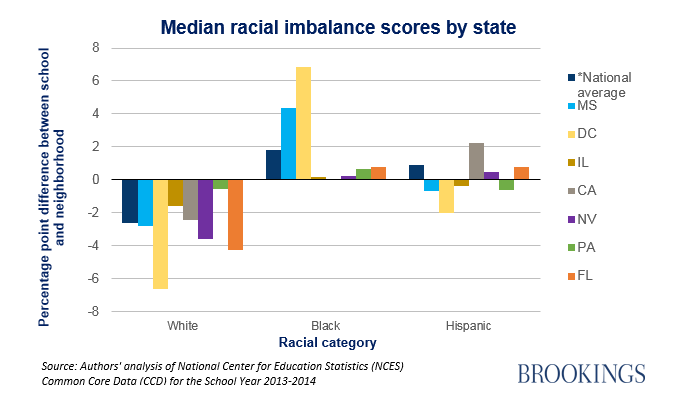
The authors find that many schools are similar, in terms of their racial composition, to the neighborhoods in which they are located. The average U.S. public school (including charter and magnet schools) is 2.6 percent less white, 1.8 percent more black, and 0.9 percent more Hispanic than its surrounding neighborhood.

More schools are “outliers” in terms of black student representation


Though most schools are similar to their surrounding neighborhoods, approximately one-third are outliers. Further, schools that qualify as outliers tend to have either an overrepresentation of black and Hispanic students, or an underrepresentation of white students.
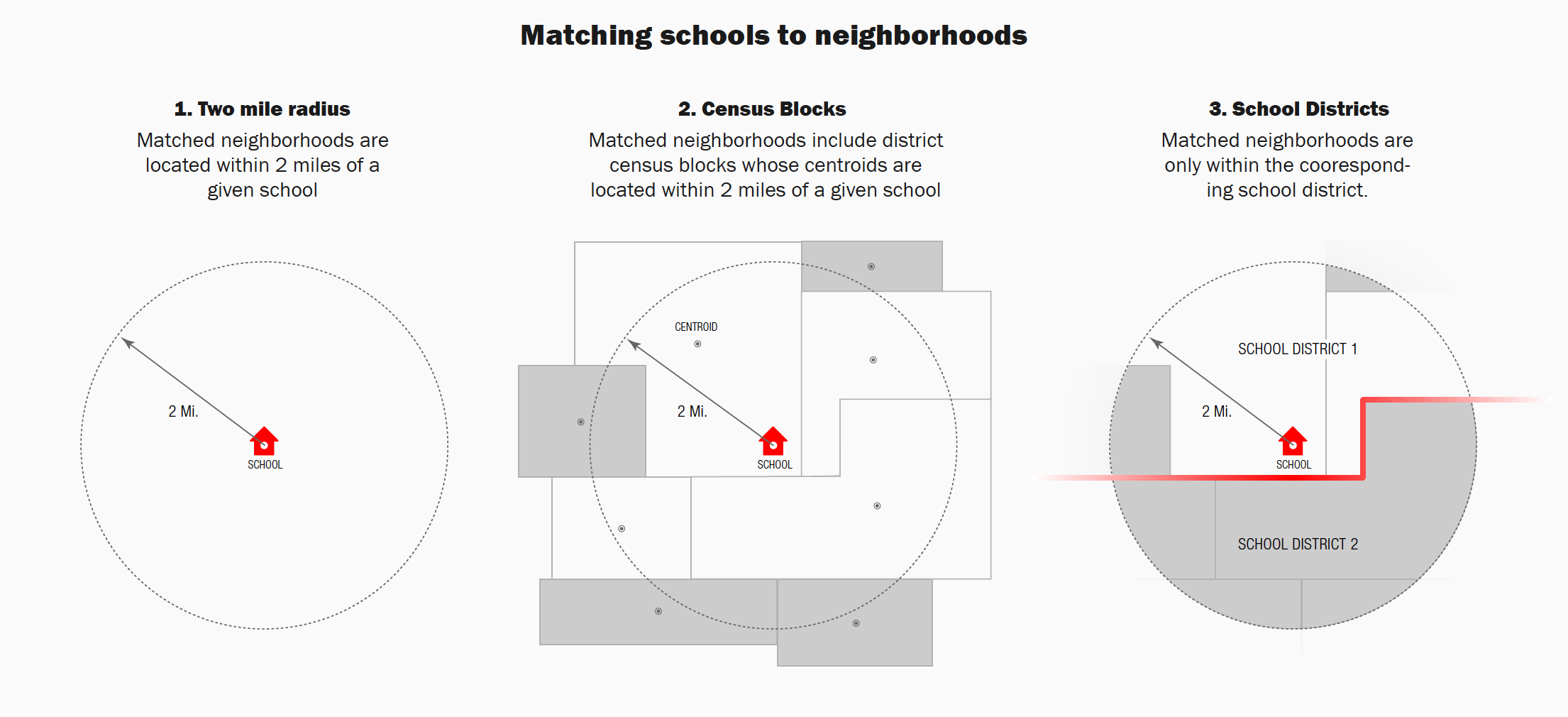
To better understand what it means to be an outlier, it helps to understand more about the methodology. First, the authors match school to neighborhoods like this:
SchoolSeg_Explainer_withType


Then they determined whether a school is an outlier for each racial category (white, black, Hispanic) based on the degree to which the racial imbalance between a school and its neighborhood is substantially outside its own state’s pattern of school-neighborhood differences, assuming a normal distribution.
This means there are some schools—in Washington, D.C. or Mississippi, for instance—where the black or white student populations are underrepresented or overrepresented by as much as 30 percent compared to their neighborhoods, but aren’t classified as an outlier. That’s because the threshold for determining outliers varies by state, and some states or districts—like D.C. or Mississippi—have higher thresholds because the state’s range of imbalance scores is wider.

Charters show more racial imbalance, especially in terms of their black student populations. But why?

Charter schools tend to have an overrepresentation of black students compared to their surrounding neighborhoods. In contrast, Hispanics are underrepresented in charter schools. So why is this? The most obvious explanation is that charters allow students to attend schools outside of their neighborhoods. But as the authors argue, it’s a bit more complicated than that.
The authors find no substantial correlation between the quality of statewide charter school laws and racial imbalance. At the same time, they don’t find anything beyond a modest correlational relationship between the degree to which charter schools may act as substitutes to traditional public schools (based off of geographic proximity) and charter school racial imbalance.

Schools in some states show more racial imbalance than others

There is also significant state-level variation in the racial imbalance of schools. In the regions with higher minority concentration, the South (for black Americans) and the West (for Hispanic Americans), the chances of seeing larger racial imbalances in public schools increases.
ES_20171117_Racial_Imbalances_By_State
The authors aren’t able to conclude whether this is because more minority density translates into more opportunity for minority populations to freely form more homogenous schools or because it translates into increased propensity for white-flight from the school system.

School district boundaries divide some communities along racial lines

For some school districts across the country, the way district lines have been drawn masks the extent to which schools don’t look like their surrounding neighborhoods in terms of race.
In Long Island, for example, school districts are quite small (the island is 1,400 square miles and has 125 districts, with the typical district having only one high school). When the authors relax the boundaries of their analysis and ignore district lines (incorporating schools outside of the school district, but within the 2-mile neighborhood radius), they find the racial imbalance in some of these “gerrymandered” school districts grows dramatically.
For more on how gerrymandered districts affect the racial makeup of some U.S. schools, read more on the Social Mobility Memos blog.

Conclusion

School-level data on racial imbalances can be valuable for a number of reasons, especially for local policymakers trying to understand the effect their policies may have on the racial makeup of local schools. Many localities such as Wake County, Boston, Charlotte, and Seattle have ended or substantially curtailed their efforts at K-12 school integration. Since 2000, at least 71 communities across the country have attempted to create new, smaller school districts (47 have been successful). Some fear such action could lead to greater segregation in public schools.
The authors emphasize caution, however, against drawing overly broad conclusions. The fact a school is more black than its surrounding neighborhood may be the result of intentional policy and is not necessarily good or bad. And when it comes to charters, the authors find it’s equally likely that they could lead to a deepening of segregation (in part by allowing for black students and white students to choose schools in which students of their race dominate enrollment) or they could reduce it and lead to greater equity (by loosening the connection between neighborhood and school).
The authors conclude that though recent history has seen a decrease in policy to encourage integration, it’s still possible to increase school diversity.
“The variation in the racial composition of schools across different districts shows that it is possible to increase integration. But it is important to be aware that this will be challenging given such high levels (still) of residential racial segregation, area based attendance policies, and a natural preference of many parents to send their children to a nearby school. Schools make the degree of residential segregation highly visible. School segregation is a symptom of residential segregation; which lies outside the scope of this paper.”

Wednesday, July 12, 2017

Taking a Different Approach to Inequality

NYT 4/30/17: S Mullainathan

Most Americans view current levels of economic inequality as a problem: In fact, for 30 years, Gallup polls have consistently found a clear majority supporting a more even distribution of wealth and income.
But there is far less agreement on how to achieve that goal. Do we need to level the playing field so that people born to modest circumstances have a better chance? Should we be trying to instill a stronger work ethic in the United States, and build a more robust culture of hard work? Counterproductive and, at times, bitter arguments bog down the search for solutions.
A recent paper by the psychologists Shai Davidai of the New School of Social Research and Thomas Gilovich of Cornell University reveals a quirk in human psychology that, I think, is responsible for some of our failure to make much progress on those issues. Understanding that quirk could help us find common ground on how to help the poorest Americans.
In public talks, Mr. Gilovich illustrates the research findings by This bias is embedded in our day-to-day lives. Most of our time and energy goes toward overcoming the challenges immediately in front of us. Headwinds demand attention because they must be overcome. Tailwinds may evoke a momentary sense of well-being and gratitude; but primarily, they free us to focus elsewhere, on challenges that must be overcome.
Mr. Davidai and Mr. Gilovich show some of the broader social and political consequences of this psychological asymmetry. They find, for example, that both Democrats and Republicans believe that electoral maps are not apportioned to their advantage. The scholars also find that, within families, people tend to think their parents were tougher on them than their siblings recognize.
Of course, we don’t really know what is going on inside everyone’s mind, but it does appear that many of us overrepresent the obstacles we face.
In many autobiographies, for example, even fortunate people, born to rich, loving families, look back on life and remember all the things that stood in their way. Not only do we play the starring role in our own life stories, but those stories often revolve around struggle.
I see this tendency in myself. When it comes to education, I have won not just one but several birth lotteries: Many children born next to me in rural India struggled to obtain anything beyond simple primary education and maybe a decent high school. Yet I had some of the best educational resources placed right in front of me all the way through my doctorate at Harvard.
I would be foolish if I did not remind myself of these advantages every day. Yet it is telling that I do need to remind myself. My spontaneous thoughts are of the challenges I faced, not the advantages I had.
This cognitive bias, I think, sheds light on persistent disagreements over inequality and opportunity that affect many of us in American society.
When we see our own past in terms of the headwinds we managed to overcome, it is easy to attribute the failure of others to a lack of perseverance. When poor children drop out of high school, someone who complains that these children don’t have an adequate work ethic may be remembering educational hurdles that she managed to surmount early in her own life.
We often disagree over the source of our success: Those who emphasize the existence of birth lotteries point to the easy ride the well-off have had. Yet relatively privileged people may look at their own lives and feel, “I’ve struggled too.”
Arguing about these perceptions doesn’t seem to be productive. We may try a different approach. Poverty, after all, is not only caused by strong headwinds; it is also characterized by a lack of tailwinds. If we work on creating more tailwinds — by giving poor children more advantages — we can solve many otherwise intractable problems.
Consider that by high school, poor children are doing much worse than those from well-off families. Researchers have found that most of this gap accumulates not during the school year, but in the summer months. In Baltimore, for example, a study has found that the entire achievement gap between the poor and the well-off is accounted for by learning disparities in the summer.
During these months, richer children benefit from summer programs and books around the house, and, more broadly, from the myriad advantages of having parents with the resources, knowledge and time to intellectually engage them. Even conversation around the dinner table can be a tailwind.
Closing the achievement gap could, then, be about generating tailwinds for poor children. In many ways, the provision of decent public education is itself a tailwind; it is, if not a complete equalizer, more equal than home life. But we could do more. For example, some have suggested the creation of a Summer Opportunity Scholarship to help low-income youth.
From a public policy perspective, it may be easier to agree on creating tailwinds than on removing headwinds. Even people who take great pride in having gotten ahead through hard work can, if prompted and upon reflection, recognize the tailwinds that helped them. This recognition does not detract from their genuine effort. Instead, it can be a moment to be thankful, perhaps for a family member who believed in you, or an unexpected piece of good fortune at just the right time.
By focusing on tailwinds, we can sidestep potential disagreements about the role of personal responsibility and initiative. Even with a tailwind, hard work is still needed; that work just yields more reward. A summer scholarship is not a substitute for serious effort.
We could garner support for such programs by asking people to remember the tailwinds in their past: It is a small step from gratitude for one’s blessings to the realization that everyone can use a little help, the poor most of all.
Sendhil Mullainathan is a professor of economics at Harvard. Follow him on Twitter at @m_sendhil.

Tuesday, April 18, 2017

Black and Proud. Even if Strangers Can’t Tell.

Black and Proud. Even if Strangers Can’t Tell. 


By REBECCA CARROLL
APRIL 1, 2017

My 11-year-old is understated, but not shy. He likes to bake, loves video games, is loyal to his friends and, biased as I may be, is a pretty good-looking kid. He gets mad sometimes, though, that people don’t immediately register him as black. “You’re so lucky,” he said to me a few months ago. “People look at you and know that you are black.”

Being black in America has historically been determined by whether or not you look black to nonblack people. This keeps racism operational. Brown and black skin in this country can invite a broad and freewheeling range of bad behavior — from job discrimination to a child being shot dead in the street. For my son, though, being black in America is about more than his skin color. It’s about power, confidence, culture and belonging.

You inherit race, though. You don’t steal it. We’re reminded of this once again by Rachel Dolezal, the white woman who made national headlines in 2015 for claiming a black identity because she felt like it. She released a memoir last week.

For the record, Ms. Dolezal, who has legally changed her name to Nkechi Amare Diallo, is white. She is the biological child of white parents who have stated publicly that their daughter is a white woman falsely identifying as black.

Ms. Dolezal’s story demonstrates our unnerving trajectory from 2015, when white privilege was a zeitgeisty phrase people might apply to certain egregious behavior — like using your white privilege to decide you are black because you feel an affinity for corn rows and weaves — to the white supremacy of the Trump administration.

I was adopted into a white family, and the only black birth-family members I am aware of are no longer living. Every day I am saddened by the fact that I don’t have any black relatives for my son to know and spend time with. But my son has me, and I have him. And we are black. He also has his father, my husband, a white man of Italian descent, which accounts for our son’s light-skinned appearance.

My son is not the only light-skinned, mixed or biracial person I know who identifies primarily as black. Increasingly, I have observed my adult peers and colleagues who fall into this category not merely identifying as black, but routinely pulling out the receipts to prove their blackness.

Some of this may have to do with what the brilliant Jordan Peele, who is also biracial and black, tapped into for the plot of his genre-redefining box office hit, “Get Out” — that it’s cool to be black right now, that we are trending.

In the more than two years since Michael Brown was fatally shot by police in Ferguson, Mo., and the city erupted in anger and unrest, increasing the visibility of the Black Lives Matter movement, we have borne witness to the very best of who we are as black people in this country. The atrocities continue — the glaring police brutality, the staggeringly disproportionate numbers of black men in the prison system, the racial wage gap and any number of other disparities that come along with a nation founded upon enslavement of nonwhite people — but we galvanize our grief.

Our new president campaigned directly to those white people who are terrified by our resolve to not merely survive, but to represent America as something other than demoralized chattel. President Trump can try to reduce us to “the blacks” who are all relegated to life in the “inner cities,” which “are a disaster education-wise, job-wise, safety-wise, in every way possible,” but I suspect that’s because he knows he has already lost control of the narrative.

In the 1970s Warner, N.H., then a town with a population under 1,500, where census data indicates that I represented the black population in its entirety, I used to love watching “The Wiz.” I could look at Diana Ross as Dorothy, with her chic round Afro, brown skin and ruby slippers, and Michael Jackson, whimsical and fluid as the Scarecrow — the part I eventually got to play in my dance class production of the show — all day.

In middle school, I spent a lot of time trying to explain to my white classmates that even though I look black, I am actually biracial — my birth mother is white and my birth father is black — and so I wasn’t really as black as they thought. What’s more, my adolescent logic went, my adopted parents are white, so that should count for something, right? People were seldom interested. At best, I heard this: “We don’t even think of you as black anyway.”

It was a comment that, based on how I thought then, should have made me feel better than it did. After all, wasn’t that what I wanted? To be considered an equal? It took me a long time before I understood that being an equal in an exclusively white environment meant erasing and devaluing my blackness. As a young adult, though, I did come to realize that wholly embracing my blackness, not explaining it away to classmates or friends, comes with a mighty and magnificent sense of joy, which I hope will serve as a model for my son to keep doing the same.

So it’s profound to me that my light-skinned son, who identifies as both mixed and black, was upset when he started sixth grade last fall at a new school where his new racially diverse peer group expressed confusion about his background.

When my son first started to black identify at about 5 or 6 years old, an acquaintance of ours asked my husband, in my presence, if he felt like we were “depriving” our son of his “white side.” My husband, a sociology professor and the author of two books on the failure of housing and school desegregation in the United States, said: “If my parents had instilled any Italian culture in me, I might want to share that with my son. But if you’re talking about general whiteness, there’s nothing there to pass down.”

This acquaintance, it seemed, was suggesting that by encouraging our son to embrace his blackness, we were depriving him of something bigger and greater than the already big and great benefit of white privilege. That my son sees more power in centering his blackness over exploiting whatever white privilege he may ultimately be afforded is a thing of glory.

Tuesday, April 11, 2017

Who Needs Charters When You Have Public Schools Like These?

Who Needs Charters When You Have Public Schools Like These?

By David L. Kirp

Published April 1, 2017
NY Times

TULSA, Okla. — The class assignment: Design an iPad video game. For the player to win, a cow must cross a two-lane highway, dodging constant traffic. If she makes it, the sound of clapping is heard; if she’s hit by a car, the game says, “Aw.” 

“Let me show you my notebook where I wrote the algorithm. An algorithm is like a recipe,” Leila, one of the students in the class, explained to the school official who described the scene to me.

You might assume these were gifted students at an elite school. Instead they were 7-year-olds, second graders in the Union Public Schools district in the eastern part of Tulsa, Okla., where more than a third of the students are Latino, many of them English language learners, and 70 percent receive free or reduced-price lunch. From kindergarten through high school, they get a state-of-the-art education in science, technology, engineering and math, the STEM subjects. When they’re in high school, these students will design web pages and mobile apps, as well as tackle cybersecurity and artificial intelligence projects. And STEM-for-all is only one of the eye-opening opportunities in this district of around 16,000 students.

Betsy DeVos, book your plane ticket now.

Ms. DeVos, the new secretary of education, dismisses public schools as too slow-moving and difficult to reform. She’s calling for the expansion of supposedly nimbler charters and vouchers that enable parents to send their children to private or parochial schools. But Union shows what can be achieved when a public school system takes the time to invest in a culture of high expectations, recruit top-flight professionals and develop ties between schools and the community.

Union has accomplished all this despite operating on a miserly budget. Oklahoma has the dubious distinction of being first in the nation in cutting funds for education, three years running, and Union spends just $7,605 a year in state and local funds on each student. That’s about a third less than the national average; New York State spends three times more. Although contributions from the community modestly augment the budget, a Union teacher with two decades’ experience and a doctorate earns less than $50,000. Her counterpart in Scarsdale, N.Y., earns more than $120,000.

“Our motto is: ‘We are here for all the kids,’ ” Cathy Burden, who retired in 2013 after 19 years as superintendent, told me. That’s not just a feel-good slogan. “About a decade ago I called a special principals’ meeting — the schools were closed that day because of an ice storm — and ran down the list of student dropouts, name by name,” she said. “No one knew the story of any kid on that list. It was humiliating — we hadn’t done our job.” It was also a wake-up call. “Since then,” she adds, “we tell the students, ‘We’re going to be the parent who shows you how you can go to college.’ ”

Last summer, Kirt Hartzler, the current superintendent, tracked down 64 seniors who had been on track to graduate but dropped out. He persuaded almost all of them to complete their coursework. “Too many educators give up on kids,” he told me. “They think that if an 18-year-old doesn’t have a diploma, he’s got to figure things out for himself. I hate that mind-set.”

This individual attention has paid off, as Union has defied the demographic odds. In 2016, the district had a high school graduation rate of 89 percent — 15 percentage points more than in 2007, when the community was wealthier, and 7 percentage points higher than the national average.

The school district also realized, as Ms. Burden put it, that “focusing entirely on academics wasn’t enough, especially for poor kids.” Beginning in 2004, Union started revamping its schools into what are generally known as community schools. These schools open early, so parents can drop off their kids on their way to work, and stay open late and during summers. They offer students the cornucopia of activities — art, music, science, sports, tutoring — that middle-class families routinely provide. They operate as neighborhood hubs, providing families with access to a health care clinic in the school or nearby; connecting parents to job-training opportunities; delivering clothing, food, furniture and bikes; and enabling teenage mothers to graduate by offering day care for their infants.

Two fifth graders guided me around one of these community schools, Christa McAuliffe Elementary, a sprawling brick building surrounded by acres of athletic fields. It was more than an hour after the school day ended, but the building buzzed, with choir practice, art classes, a soccer club, a student newspaper (the editors interviewed me) and a garden where students were growing corn and radishes. Tony, one of my young guides, performed in a folk dance troupe. The walls were festooned with family photos under a banner that said, “We Are All Family.”

This environment reaps big dividends — attendance and test scores have soared in the community schools, while suspensions have plummeted.

The district’s investment in science and math has paid off, too. According to Emily Lim, who runs Union’s STEM program, the district felt it was imperative to offer STEM classes to all students, not just those deemed gifted.

In one class, I watched eighth graders create an orthotic brace for a child with cerebral palsy. The specs: The toe must be able to rise but cannot fall. Using software that’s the industry standard, 20 students came up with designs and then plaster of Paris models of the brace.

“It’s not unusual for students struggling in other subjects to find themselves in the STEM classes,” Ms. Lim said. “Teachers are seeing kids who don’t regard themselves as good readers back into reading because they care about the topic.”

A fourth grader at Rosa Parks Elementary who had trouble reading and writing, for example, felt like a failure and sometimes vented his frustration with his fists. But he’s thriving in the STEM class. When the class designed vehicles to safely transport an egg, he went further than anybody else by giving his car doors that opened upward, turning it into a little Lamborghini. Such small victories have changed the way he behaves in class, his teacher said — he works harder and acts out much less.

Superintendents and school boards often lust after the quick fix. The average urban school chief lasts around three years, and there’s no shortage of shamans promising to “disrupt” the status quo.

The truth is that school systems improve not through flash and dazzle but by linking talented teachers, a challenging curriculum and engaged students. This is Union’s not-so-secret sauce: Start out with an academically solid foundation, then look for ways to keep getting better.

Union’s model begins with high-quality prekindergarten, which enrolls almost 80 percent of the 4-year-olds in the district. And it ends at the high school, which combines a collegiate atmosphere — lecture halls, student lounges and a cafeteria with nine food stations that dish up meals like fish tacos and pasta puttanesca — with the one-on-one attention that characterizes the district.

Counselors work with the same students throughout high school, and because they know their students well, they can guide them through their next steps. For many, going to community college can be a leap into anonymity, and they flounder — the three-year graduation rate at Tulsa Community College, typical of most urban community colleges, is a miserable 14 percent. But Union’s college-in-high-school initiative enables students to start earning community college credits before they graduate, giving them a leg up.

The evidence-based pregnancy-prevention program doesn’t lecture adolescents about chastity. Instead, by demonstrating that they have a real shot at success, it enables them to envision a future in which teenage pregnancy has no part.

“None of this happened overnight,” Ms. Burden recalled. “We were very intentional — we started with a prototype program, like community schools, tested it out and gradually expanded it. The model was organic — it grew because it was the right thing to do.”

Building relationships between students and teachers also takes time. “The curriculum can wait,” Lisa Witcher, the head of secondary education for Union, told the high school’s faculty last fall. “Chemistry and English will come — during the first week your job is to let your students know you care about them.”

That message resonated with Ms. Lim, who left a job at the University of Oklahoma-Tulsa School of Community Medicine and took a sizable pay cut to work for Union. “I measure how I’m doing by whether a girl who has been kicked out of her house by her mom’s boyfriend trusts me enough to tell me she needs a place to live,” she told me. “Union says, ‘We can step up and help.’ ”

Under the radar, from Union City, N.J., and Montgomery County, Md., to Long Beach and Gardena, Calif., school systems with sizable numbers of students from poor families are doing great work. These ordinary districts took the time they needed to lay the groundwork for extraordinary results.

Will Ms. DeVos and her education department appreciate the value of investing in high-quality public education and spread the word about school systems like Union? Or will the choice-and-vouchers ideology upstage the evidence?


David L. Kirp is a professor at the University of California, Berkeley, a senior fellow at the Learning Policy Institute and a contributing opinion writer.